Navigating the NQS: A Practical Guide to Quality Area 1
The National Quality Standard (NQS) is the benchmark for quality in early childhood education and care (ECEC) services across Australia. While all seven Quality Areas are interconnected and vital, Quality Area 1 (QA1): Educational Program and Practice is arguably the heart of your service, directly impacting children's learning, development, and wellbeing.
QA1 focuses on whether the educational program and practice of your service are stimulating and engaging, and enhance children's learning and development. It's where the theoretical frameworks like the Early Years Learning Framework (EYLF) V2.0 come to life. Many services find QA1 both inspiring and challenging. Let's break down how to effectively navigate this crucial area.
Understanding the Core: Intent of Quality Area 1
At its core, QA1 asks: Is your service providing an educational program that is child-centred, promotes holistic development, and reflects current research and best practice?
It encompasses three key standards:
Bringing QA1 to Life: Practical Strategies
Here’s how you can demonstrate excellence in Educational Program and Practice within your service:
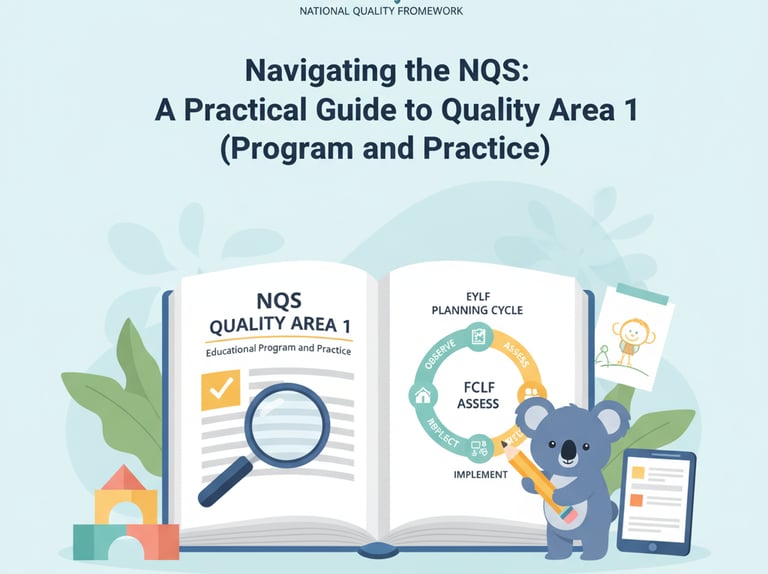
1. Embrace the EYLF V2.0 Planning Cycle (Observe, Assess, Plan, Implement, Reflect)
QA1, particularly Standard 1.3, demands ongoing critical reflection.
Individual & Team Reflection: Encourage educators to reflect on their own practice and facilitate team discussions. What biases might be influencing practice? How can the program better cater to diverse learners?
Incorporate Family & Community Input: Actively seek feedback from families about their child's learning and cultural context. Use this information to enrich your program and make it more responsive.
Reflect on the Frameworks: Critically reflect on how the EYLF V2.0 (and where applicable, the Victorian Early Years Learning and Development Framework or VEYLDF in Victoria) is being implemented, ensuring it's not just a document but a lived practice.
Partnering for QA1 Excellence
Navigating NQS Quality Area 1 can feel like a complex journey, but you don't have to do it alone. As experienced Early Care Policy, Training, and Compliance Consultants, we specialise in supporting services across Australia to not just meet, but exceed the NQS.
We offer:
EYLF V2.0 Implementation Workshops: Practical training on applying the updated framework.
Program & Practice Audits: In-depth reviews to identify strengths and areas for growth in QA1.
Documentation Training: Empowering educators to create meaningful, compliant learning documentation.
Critical Reflection Coaching: Guiding leaders and teams to embed reflective practices.
Contact us today to strengthen your educational program and practice and confidently achieve excellence in Quality Area 1.
Standard 1.1: Program is child-centred, stimulating and engaging: This means the program is based on children's interests, strengths, and abilities, and challenges them to learn and grow.
Standard 1.2: Practice is child-focused, promotes learning and equity: This focuses on how educators interact with children, using intentional teaching, scaffolding, and fostering positive relationships.
Standard 1.3: Curriculum decision-making is collaborative and based on critical reflection: This highlights the importance of ongoing assessment, planning, and reflection, involving children, families, and the wider community.
4. Critical Reflection: A Culture of Continuous Improvement
This cycle is the backbone of effective programming. Don't just tick boxes; truly integrate each step:
Observe: Consistently and intentionally observe children's play, interactions, and learning. What are their interests? What are they trying to achieve? What skills are emerging?
Assess: Analyse your observations. What does this tell you about the child's learning and development in relation to the EYLF V2.0 Learning Outcomes? Identify strengths, interests, and potential areas for scaffolding.
Plan: Based on your assessment, plan meaningful experiences and environments. This isn't just a daily roster; it's about intentional teaching strategies, resource provision, and extending children's learning.
Implement: Put your plans into action, remaining flexible and responsive to children's immediate needs and interests.
Reflect: Critically reflect on the effectiveness of your program and practice. What worked well? What could be improved? How did children respond? How can you enhance children's learning outcomes?
2. Documenting Learning: Quality Over Quantity
Documentation is vital for demonstrating your practice, but it doesn't need to be overwhelming.
Focus on the "Why": Instead of simply describing an activity, explain why it was offered, what learning occurred (linking to EYLF V2.0 Outcomes), and what next steps are planned.
Diverse Methods: Use a variety of documentation methods – photos with annotations, learning stories, mind maps, floor books, children's own contributions, and digital portfolios. Ensure accessibility for families.
Individual & Group Learning: Document both individual children's journeys and the collective learning of the group.
3. Intentional Teaching and Meaningful Interactions
This is where skilled educators truly shine.
Beyond Facilitation: While child-led play is crucial, educators should also engage in intentional teaching—purposeful, thoughtful, and deliberate acts to extend children's learning. This includes asking open-ended questions, providing specific feedback, modelling skills, and challenging thinking.
Scaffolding Learning: Understand each child's current capabilities and provide just enough support to help them achieve the next step in their learning, gradually withdrawing support as they become more competent.
Building Relationships: Warm, respectful, and responsive relationships with children are fundamental. These relationships create a secure base from which children can explore, learn, and take risks.
Simplifying compliance so educators can focus on children’s learning and wellbeing.
© 2026. All rights reserved.