Family Day Care vs. Long Day Care: A Policy and Compliance Breakdown for New Providers
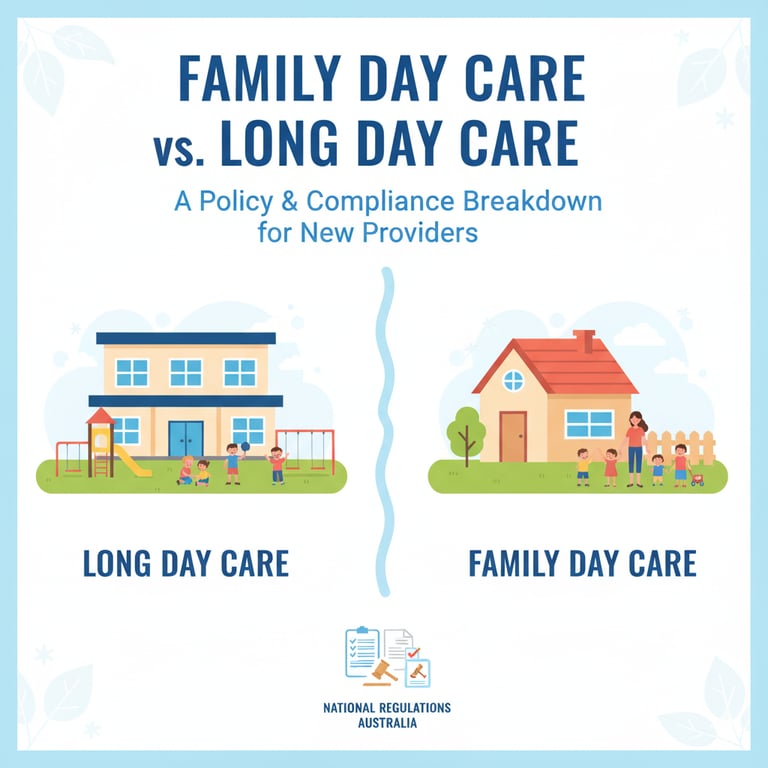
Deciding to open an early childhood education and care service in Australia is an exciting venture. However, one of the first critical choices you'll face is whether to establish a Family Day Care (FDC) or a Long Day Care (LDC) service. While both fall under the National Quality Framework (NQF), their operational models lead to distinct policy and compliance requirements.
For new providers, understanding these differences is crucial for setting up a successful and compliant service. Let's break down the key distinctions.
The Core Difference: Environment and Scale
The most fundamental difference lies in the setting and the number of children cared for.
Key Policy and Compliance Distinctions
While both service types must comply with the Education and Care Services National Law and Regulations and the National Quality Standard (NQS), how these are applied differs significantly.
3. Governance and Management Structure
LDC: Has a more traditional hierarchical structure, with an Approved Provider, Nominated Supervisor, and often a Centre Director, team leaders, and educators.
FDC: Involves two key components:
The FDC Educator: An individual operating their business from home, responsible for day-to-day care and programming.
The Approved FDC Service (Coordination Unit): This entity is the "Approved Provider" under the NQF. It's responsible for monitoring, supporting, training, and ensuring the compliance of all educators working under its scheme. This includes regular home visits, record keeping, and quality assurance.
4. Policies and Procedures
LDC: Develops a comprehensive suite of policies and procedures tailored to a larger, multi-staffed centre environment.
FDC: Policies are usually developed by the Approved FDC Service (coordination unit) and then implemented by the individual FDC educators. Educators also develop their own specific operational procedures unique to their home environment. These policies must cover home-specific risks, such as other residents in the home, visitors, and shared spaces.
Which is Right for You?
Starting a Family Day Care business
can offer greater flexibility and a smaller-scale, intimate environment, often appealing to educators who want to work from home. However, it requires a strong understanding of home-based compliance and effective collaboration with a coordination unit.Establishing a Long Day Care
involves significant capital investment and a larger operational scale, with a broader range of administrative and staffing complexities.
Expert Guidance for Your New Venture
Whether you're exploring the nuances of Family Day Care compliance or setting up a new Long Day Care centre, our consultancy services can provide the clarity and support you need. We specialise in:
Policy and Procedure Development: Tailored to your specific service type (FDC or LDC).
Compliance Audits: Ensuring your premises and practices meet all NQF requirements.
Training and Mentoring: Equipping new providers and educators with the knowledge to succeed.
Pre-Approval Support: Guiding you through the application and setup process.
Contact us today for a consultation to discuss your vision and ensure your new early childhood service starts on a foundation of robust policy and compliance.
Long Day Care (LDC):
Typically operates from purpose-built or adapted commercial premises.
Cares for larger groups of children across multiple age rooms (e.g., babies, toddlers, preschoolers).
Employs a team of educators and a dedicated management structure.
Often has shared outdoor play spaces and dedicated indoor learning environments.
Examples include standalone childcare centres, or those attached to schools or workplaces.
Family Day Care (FDC):
Operates from an educator's private home.
Cares for smaller, mixed-age groups of children (often a maximum of 4 children under school age, plus 3 school-aged children, though this can vary by state/territory regulations).
The primary educator is usually self-employed and works under the guidance of an approved FDC service (the coordination unit).
The home environment is adapted to meet safety and educational requirements, including indoor and outdoor play spaces.
1. Premises and Environment Requirements
LDC: Must meet stringent requirements for building size, layout, kitchen facilities, toilets, nappy change areas, and dedicated indoor/outdoor unencumbered space per child. These are typically assessed against commercial building standards.
FDC: The educator's home becomes the approved venue. Compliance focuses on adapting a residential space for child care. This includes:
Safety Audit: Comprehensive safety checks of all indoor and outdoor areas, including fencing, pools, chemicals, and potential hazards.
Shared Spaces: How the family's living space is managed to ensure it's safe and conducive to children's learning.
Sleep and Rest Areas: Ensuring appropriate, safe sleep spaces are available.
Excursions and Transportation: Policies for taking children out of the home environment.
2. Staffing and Ratios
LDC: Strict educator-to-child ratios apply, often differentiated by age group (e.g., 1:4 for babies, 1:11 for preschoolers in Victoria). Specific qualification requirements, including Early Childhood Teachers (ECTs), must be met for certain hours.
FDC: Ratios are typically much smaller (e.g., maximum of 7 children in total, with specific limits for children under school age). The FDC educator is the primary caregiver, but the coordination unit plays a vital role in monitoring, support, and ensuring compliance across all educators under its scheme.
Regardless of your choice, thorough planning and a deep understanding of Family Day Care regulations Australia or Long Day Care compliance are essential.
Simplifying compliance so educators can focus on children’s learning and wellbeing.
© 2026. All rights reserved.